TOK in IB Diploma and the Meaning of Theory of Knowledge

Blog1 June 20266 min read

If you are new to the IB Diploma, Theory of Knowledge is probably the component that sounds the most mysterious. Students often hear the name and immediately ask - is it a philosophy class? Is it an exam? Do I have to memorise anything? And parents frequently wonder - what does this have to do with getting into university?


This guide answers all of those questions simply and honestly, with plenty of real examples along the way.


So, What Actually Is TOK?


Theory of Knowledge is a compulsory course in the IB Diploma that asks one big question:


How do we know what we know?


That is it. That is the heart of the course. Not what do we know, but how do we know it - and how confident can we really be?


Think about it this way. Your child sits in a Biology class and learns that the heart pumps blood around the body. They accept this as fact. But TOK asks - how did we come to know this? How did scientists figure it out? Could we have been wrong at some point in history? Are there things we currently believe to be true that future generations will look back on and find mistaken? How does the way we measure things affect what we find?


These are not easy questions. But they are exactly the kind of questions that universities - and the world beyond - need young people to be able to engage with.


Why Does the IB Include TOK?


The IB includes TOK because it believes that a truly educated person does not just accumulate facts - they understand the nature and limits of knowledge itself.


A student who only knows facts is useful in a stable world. A student who also understands how knowledge is produced, challenged, and revised is equipped to navigate a changing one.


Consider this: in 1900, doctors believed that stomach ulcers were caused by stress and diet. This was established medical knowledge for decades. In 1984, two Australian scientists proved that most ulcers are actually caused by a bacterial infection. The entire medical establishment had been confidently wrong for generations. One of those scientists, Barry Marshall, drank the bacteria himself to prove his point - and eventually won the Nobel Prize.


TOK asks students to think about moments like this. How does scientific knowledge change? What counts as evidence? When should we trust experts? When should we question them?


What Do Students Actually Do in TOK?


TOK is taught as a regular class throughout the two years of the DP. There are no textbooks to memorise. Instead, students discuss, debate, read, write, and think - a lot.


The course is organised around two key ideas.


The first is Areas of Knowledge - the different domains of human enquiry, such as the Natural Sciences, the Human Sciences, History, Mathematics, and  the Arts. Students explore how knowledge works differently in each domain - how a historian knows something is different from how a physicist knows something, which is different again from how an artist knows something.


The second is the concepts. In IB Theory of Knowledge (TOK), the 12 concepts help students explore how knowledge is created, shared, challenged, and applied. These concepts are not meant to be studied in isolation; rather, they are lenses through which knowledge questions can be examined across five Areas of Knowledge (AOKs), one core theme – knowledge and the knower – and across two optional themes.


The goal is not to arrive at definitive answers. The goal is to develop the capacity to ask better questions.


A Simple Real-Life Example


Here is an example that works well for both students and parents.


Imagine your child watches a news report about a new study saying that coffee is good for your health. The following week, they see another report saying coffee is bad for your health. Both reports cite scientific research. Both sound credible.


A student without TOK training might simply be confused and give up trying to know the truth.


A student with TOK training starts asking a different set of questions entirely. Who funded the research? How large was the sample? What does good for your health actually mean - good for your heart? Your sleep? Your concentration? Over what time period? What does the existing body of research say when taken as a whole, rather than as individual studies?


This is TOK in action. It does not tell you whether coffee is good or bad. It gives you the tools to evaluate the claim intelligently.


What Are the TOK Assessments?


TOK has two assessed components, and together they can contribute up to three bonus points to a student's final IB score when combined with the Extended Essay.


The TOK Exhibition


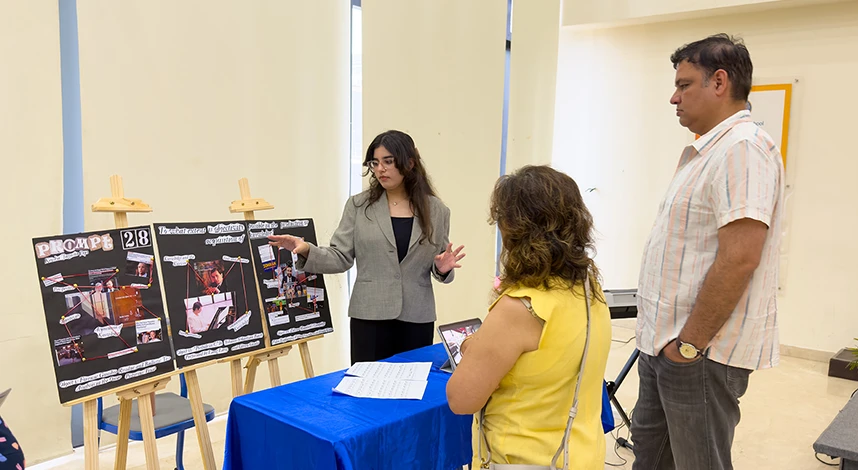
The first assessment is the Exhibition, which students complete during their first year of the DP. Students choose three objects - physical or digital - and explain how each one connects to a central TOK prompt chosen from an official IB list.


For example, a prompt might be: Are some things unknowable? A student might choose a photograph of a black hole, a personal diary, and a mathematical proof - and explain what each object reveals about the limits and possibilities of human knowledge. The Exhibition is internally assessed by the school.


The TOK Essay


The second assessment is a 1,600-word essay written in the second year of the DP on a title chosen from a list of six options provided by the IB. These titles change every year. Recent examples have included questions such as:


Is replication the cornerstone of science?


To what extent do the tools we use shape the knowledge we produce?


Does it matter if our knowledge of the past is accurate?


The essay is externally assessed by IB examiners. It requires students to draw on examples from different Areas of Knowledge, construct a clear line of argument, acknowledge counter-arguments, and demonstrate genuine critical thinking - not a rehearsed or templated response.


Why Universities Value TOK


Universities - particularly in the UK, US, and Europe - value the IB Diploma in part because of TOK. Admissions officers at leading universities know that a student who has completed the Diploma has spent two years regularly asking how they know what they know. That student arrives at university with something that cannot easily be taught in the first year: the habit of critical self-examination.


In tutorials at Oxford and Cambridge, in seminars at US liberal arts colleges, in law school moots, in medical ethics classes, and in research methodology courses worldwide, the fundamental question is the same one TOK asks from Day 1. Students who are already comfortable living in that space of productive uncertainty do better, settle in faster, and contribute more.


A Final Note for Parents


Parents sometimes find TOK the hardest part of the Diploma to connect with - precisely because it does not look like traditional studying. There are no notes to revise, no formulas to memorise, no textbook to read from cover to cover.


What TOK looks like at home is a student who comes to the dinner table with a question rather than an answer. Who reads a news article and immediately asks who wrote it and why. Who finishes a History assignment and wonders whether the sources they used were telling the whole story. Who looks at a mathematical proof and asks whether mathematics is discovered or invented.


If you start noticing these habits in your child, TOK is working exactly as intended.


References


  • International Baccalaureate Organization. Theory of Knowledge Guide. IB, 2022.
  • International Baccalaureate Organization. Theory of Knowledge - Overview. IB, www.ibo.org/programmes/diploma-programme/curriculum/theory-of-knowledge/. Accessed April 2026.
  • International Baccalaureate Organization. The TOK Exhibition. IB, resources.ibo.org. Accessed April 2026.
  • International Baccalaureate Organization. Core Requirements - Theory of Knowledge. IB, www.ibo.org/programmes/diploma-programme/curriculum/dp-core/theory-of-knowledge/. Accessed April 2026.

Let Your Child's Journey Begin at MLSI

Join one of the top IB schools in Mumbai. Experience world-class education that shapes global citizens.

Contact Us