The Primary Years Programme (PYP), developed by the International Baccalaureate Organization, is designed for children aged 3 to 12 and nurtures young learners as caring, active participants in a lifelong journey of learning.
At its core, the PYP is more than a curriculum—it is a philosophy of education that places the child at the center of the learning process, empowering them to take ownership of their learning while developing the skills needed to thrive in a rapidly changing world. Here are the key area to focus-
1. A Student-Centered, Inquiry-Based Approach
The PYP offers an inquiry-based, transdisciplinary curriculum framework that builds deep conceptual understanding. Rather than focusing only on content, it encourages students to:
- Ask meaningful questions
- Explore real-world issues
- Make connections across subject areas
This approach reflects the best of educational research and global practices, drawing on the collective experience of IB World Schools worldwide.
2. The PYP Curriculum Framework
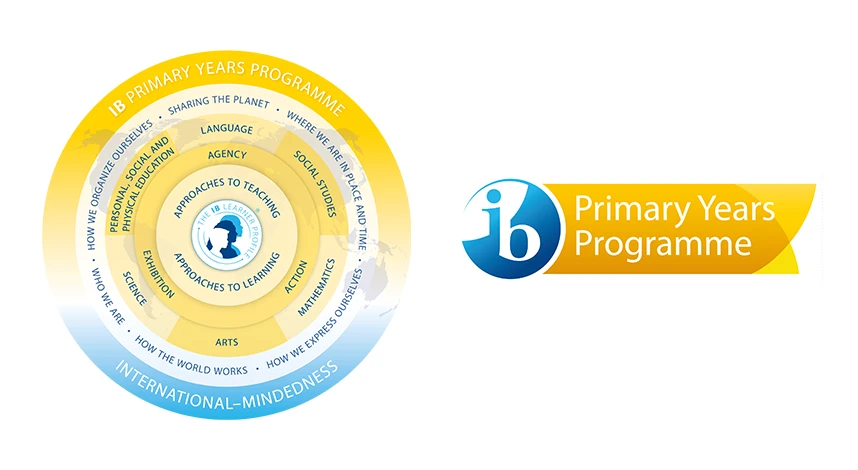
The PYP framework begins with a powerful belief: students are agents of their own learning.
It emphasizes strong relationships and a collaborative learning environment built on three key pillars:
- The learner
- Learning and teaching
- The learning community
Within this framework, students are encouraged to take initiative, reflect on their learning, and develop:
- Knowledge
- Conceptual understanding
- Skills
- Attributes of the IB Learner Profile
This holistic development empowers learners to make meaningful contributions—not only in school but also in their communities and beyond.
3. The Role of Agency and Self-Efficacy
A defining feature of the PYP is its emphasis on student agency. Learners are not passive recipients of knowledge; they actively shape their learning journey.
Closely linked to this is the development of self-efficacy—the belief in one’s ability to succeed. When students build this confidence, they:
- Take ownership of their learning
- Engage more deeply
- Act with purpose and responsibility
This creates motivated, self-driven learners who are prepared for future challenges.
4. Learning Beyond Boundaries
The PYP is guided by six transdisciplinary themes of global significance, which allow students to explore big ideas that go beyond traditional subject boundaries.
Through this approach, learners:
- Strengthen knowledge across disciplines
- Develop critical thinking and problem-solving skills
- Connect learning to real-life contexts
This ensures that education is relevant, engaging, and meaningful.
5. Why the PYP Matters
The PYP focuses on developing the whole child—academically, socially, emotionally, and physically. It provides a transformative experience by offering learning that is:
- Engaging
- Relevant
- Challenging
- Significant
Students in the PYP learn how to collaborate with teachers, reflect on feedback, and become self-regulated learners. These skills not only support academic success but also prepare them for lifelong learning.
6. A Globally Recognized Educational Framework
Over the years, the PYP has evolved into a world leader in future-focused education, responding effectively to the opportunities and challenges of today’s world.
Schools that wish to offer the PYP undergo a rigorous authorization process to become IB World Schools, ensuring high standards and a shared commitment to international-mindedness.
Final Thoughts
The IB PYP is not just about what students learn—it is about how they learn and who they become. By fostering curiosity, independence, and a sense of responsibility, the PYP equips learners with the mindset and skills needed to navigate an ever-changing world.
As education continues to evolve, the PYP stands as a powerful example of what meaningful, student-centered learning can look like.
FAQs
Que:What is the IB PYP curriculum and what age group is it designed for?
Ans: The IB Primary Years Programme (PYP) is an internationally recognised, inquiry-based curriculum framework designed for students aged 3 to 12. It nurtures the whole child — academically, socially, emotionally, and physically — through a transdisciplinary approach, meaning students learn across and beyond traditional subject boundaries rather than in isolation. The PYP is organised around six transdisciplinary themes of global significance — such as 'Who we are', 'How the world works', and 'Sharing the planet' — through which students explore key subject areas including language, mathematics, sciences, social studies, arts, and personal, social, and physical education. The PYP culminates in the PYP Exhibition, a collaborative, in-depth inquiry project in which students showcase the knowledge, understanding, and values they have developed throughout the programme.
Que:How is the IB PYP different from a traditional school curriculum?
Ans: A traditional curriculum is typically content-heavy, subject-siloed, and assessment-led — students study each subject separately and are measured primarily through written tests and exams. The IB PYP takes an entirely different approach. It is student-centred and inquiry-driven: children are treated as active agents in their own learning, not passive recipients. Rather than dividing the school day into disconnected subject periods, PYP learning is organised around transdisciplinary units of inquiry that weave together multiple subject areas around a central idea or real-world issue. Assessment in the PYP is ongoing and varied — observations, portfolios, reflections, and collaborative projects — with no external exams. Teachers observe, document, and respond to each child's learning journey, making the approach genuinely responsive to individual needs and interests.
Que: What skills does the IB PYP develop to prepare students for lifelong learning?
Ans: The PYP is specifically designed to develop the skills that underpin lifelong learning, not just academic achievement. Through its Approaches to Learning (ATL) framework, students develop five key skill sets: thinking skills (critical and creative reasoning), communication skills (reading, writing, speaking, listening across multiple modes), research skills (questioning, planning, gathering, organising, and presenting information), social skills (collaboration, conflict resolution, intercultural understanding), and self-management skills (organisation, time management, emotional regulation, and reflection). Alongside these, the PYP develops student agency — the confidence, initiative, and sense of ownership over one's learning — which is one of the most important foundations a student can have as they move into the middle and upper years of school and into adult life.
References
- International Baccalaureate Organization. (n.d.). Primary Years Programme (PYP): How the PYP works. Retrieved from https://www.ibo.org/programmes/primary-years-programme/how-the-pyp-works/
- International Baccalaureate Organization. (n.d.). The Primary Years Programme. Retrieved from https://www.ibo.org/programmes/primary-years-programme/
- International Baccalaureate Organization. (2018). Primary Years Programme: From principles into practice. Cardiff: International Baccalaureate Organization.
- International Baccalaureate Organization. (n.d.). PYP Programme Brochure. Retrieved from https://www.ibo.org/globalassets/new-structure/brochures-and-infographics/pdfs/pyp-programme-brochure-en.pdf
- genspark.ai