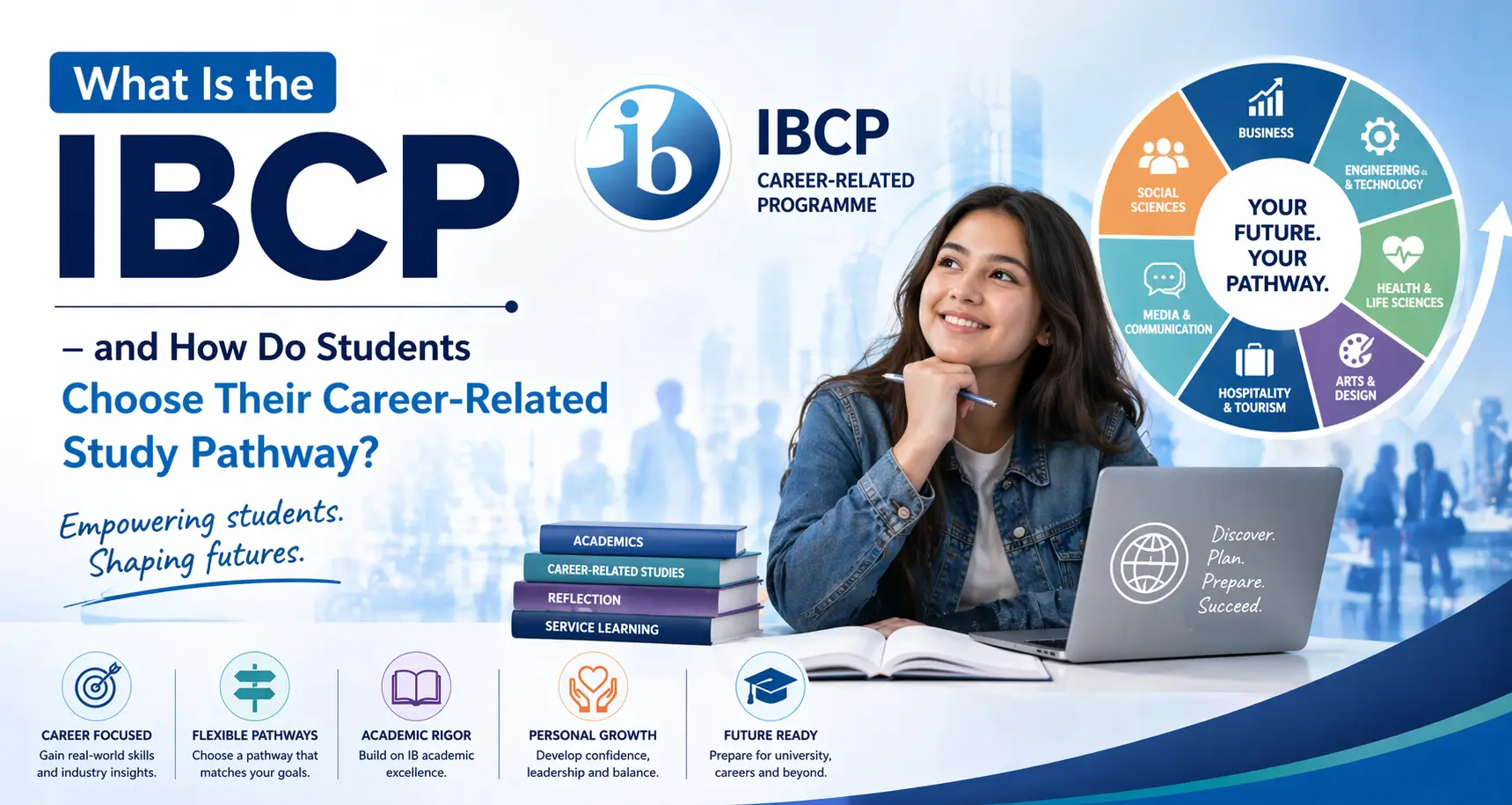
The IB Career-related Programme (IBCP) is a distinctive qualification for students aged 16–19 who want to combine the rigor of the International Baccalaureate with real, hands-on professional preparation. If your child is drawn to a specific career field but still wants an internationally recognised academic credential, the IBCP might be exactly the right fit.
What exactly is the IBCP?
The IB Career-related Programme was introduced by the International Baccalaureate Organization (IBO) in 2012. It was designed as an alternative to the more widely known IB Diploma Programme (IBDP), specifically for students who benefit from applied and experiential learning alongside traditional academic study.
Unlike the IBDP, which covers six subject groups and an Extended Essay, the IBCP centres around a career-related study - a professional qualification (such as a WACP, industry certification, or work-based training programme) - and combines it with a carefully structured IB framework that ensures academic breadth and personal development.
The four core components
Every IBCP student studies at least two IB Diploma Programme courses (suggested at least three at MLSI) from the DP courses offered at school. On top of that, the programme is built around four compulsory core elements:
Language and Cultural Studies
Students study an additional language, strengthening communication skills for a globalised workplace.
Community engagement
Structured community engagement that connects academic knowledge to real-world impact and ethical responsibility.
Reflective Project
An in-depth piece of work - typically 1,500–2,000 words - exploring an ethical issue arising from the student's career area.
Personal & Professional Skills
Personal and Professional Skills empower students to develop self-awareness, critical thinking, ethical decision-making, and practical life competencies, enabling them to navigate academic pathways and future careers with confidence and purpose.
Together, these components ensure the IBCP is far more than just a career qualification. They develop critical thinking, global citizenship, and the kind of self-awareness employers and universities increasingly look for.
The career-related study: the heart of the programme
The career-related study (CRS) is the professional qualification that sits at the centre of the IBCP. Schools partner with external providers - awarding bodies, colleges, or industry organisations - to offer a range of pathways. The CRS is often equivalent to Level 3 qualifications and is formally recognised by universities and employers.
Common career-related study areas offered in IBCP schools include:
Examples: Business Administration (WACP), Artificial intelligence (WACP)
The specific pathways available depend on the school and its external partners. Families should check with the IB Career-Related programme coordinator to see which options are currently offered.
How do students choose their pathway?
Choosing the right career-related study is one of the most important decisions a student makes when entering the IBCP. The process works best as a guided conversation - between the student, their family, IBCP Coordinator and University counsellors - rather than a snap decision. Here is how we typically approach it:
- Self-reflection and interest mapping. Students begin by exploring what genuinely interests them - not just what they are good at, but what problems they want to solve, what environments they enjoy, and what kind of future they envision. Career aptitude tools and conversations with teachers provide a useful starting point.
- Research into career fields. Students are encouraged to look beyond job titles and examine whole sectors. Job shadowing, informational interviews with professionals, and industry taster events help turn abstract interests into concrete understanding of what a career in that area actually involves day to day.
- University and progression planning. Even in Year 11 or Grade 10, it is worth considering where the pathway leads. Many IBCP students go on to university, work-based training programmes, or direct employment. The Reflective Project and IB DP courses chosen should complement the intended next step.
- Consultation with the IBCP Coordinator. Our IBCP Coordinator plays a central role in helping students understand the specific pathways available at school, the assessment requirements of each, and how to build a coherent, balanced timetable across the IBCP components.
- Choosing supportive DP subjects. The two (or more) IB Diploma Programme subjects selected should reinforce the career-related study. A student pursuing Artificial Intelligence, for example, might choose physics, mathematics and chemistry as their DP subjects.
A note for families: There is no single "right" pathway. The most successful IBCP students are those who choose a career-related study they are genuinely curious about - not the one that sounds most impressive. Enthusiasm and intrinsic motivation make an enormous difference over two years of study.
How is the IBCP assessed?
Assessment in the IBCP is a combination of the external assessments set by the career-related study provider, the IB's own moderated assessment of the Reflective Project, and the internal and external assessments of the chosen DP courses. Students receive an IBCP certificate upon successful completion, which is recognised by universities and employers across more than 90 countries.
Is the IBCP right for every student?
The IBCP suits students who have a clear (or developing) professional interest, who learn well through applied and project-based work, and who want an internationally recognised credential without the full breadth requirements of the IB Diploma. It does not suit every learner - students who want maximum university flexibility across all subject areas may find the IBDP a better fit.
That said, the IBCP is increasingly recognised by leading universities worldwide, and its graduates consistently demonstrate the kind of self-directed, reflective, and professionally aware qualities that make them stand out in admissions processes and in the workplace.
To find out more about the IBCP pathways available at our school, or to book a one-to-one guidance session with our IBCP Coordinator, please contact the school office. We hold Open House to discuss pathway information each year for students and families considering their options.
FAQ’s for What Is the IBCP - and How Do Students Choose Their Career-Related Study Pathway?
1) What is the IB Career-Related Programme, and who is it designed for?
The IB Career-Related Programme (IBCP) is an internationally recognised qualification offered by the International Baccalaureate Organization (IBO) for students aged 16–19. It combines a professional Career-Related Study with core IB components - including a Reflective Project, Language and Cultural Studies, Community Engagement, and Personal & Professional Skills - designed for students who learn best through applied, real-world contexts.
2) What does IBCP stand for, and what are its four core components?
IBCP stands for the IB Career-Related Programme. Every IBCP student completes four compulsory core components: Language and Cultural Studies, Community Engagement, a Reflective Project (an ethical inquiry of 1,500–2,000 words related to their career field), and Personal & Professional Skills - alongside at least two IB Diploma Programme subject courses.
3) How do IBCP students at MLSI choose their Career-Related Study pathway?
At MLSI, choosing a Career-Related Study (CRS) is a guided process involving the student, family, IBCP Coordinator, and University Counsellors. It begins with self-reflection and interest mapping, followed by research into career sectors, university progression planning, and selection of supportive IB Diploma Programme subjects that complement the chosen professional pathway.
4) Is the IBCP certificate recognised by universities and employers internationally?
Yes. Upon successful completion of the IB Career-Related Programme, students receive an IBCP certificate that is recognised by universities and employers across more than 90 countries. The programme's combination of a professional Career-Related Study, Reflective Project, and IB Diploma Programme courses ensures graduates are equipped for university admission, work-based training, or direct employment.