


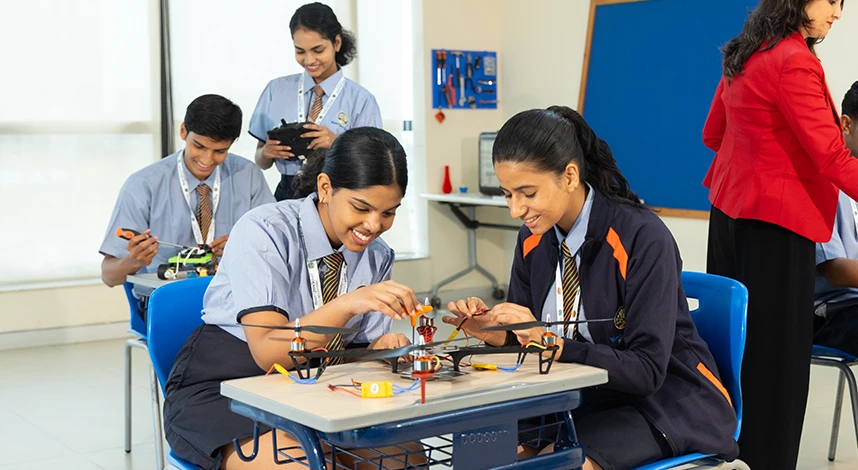
Education is no longer limited to memorizing facts or preparing for examinations. The focus has shifted towards nurturing learners who can think critically, solve problems creatively, communicate effectively, and adapt confidently to new challenges. One educational approach that strongly supports these goals is Inquiry-Based Learning, a key element of the International Baccalaureate (IB) framework.
But what exactly is inquiry-based learning, and why is it considered one of the most effective ways to prepare children for the real world?
Understanding Inquiry-Based Learning
Inquiry-Based Learning is an approach where learning begins with curiosity, questions, and exploration. Instead of simply receiving information from the teacher, students actively investigate concepts, ask meaningful questions, conduct research, collaborate with peers, and construct their own understanding.
In an inquiry-driven classroom, learners are encouraged to:
- Explore ideas deeply
- Think independently
- Make real-world connections
- Reflect on their learning
- Take ownership of their educational journey
Teachers act as facilitators who guide, support, and challenge students to think beyond textbooks and discover knowledge through experiences.
For example, instead of only learning about pollution through definitions, students may investigate how waste affects their local community, interview experts, propose sustainable solutions, and present their findings. This makes learning authentic, engaging, and purposeful.
How the IB Approach Uses Inquiry
The IB framework places inquiry at the heart of learning. Through transdisciplinary learning experiences, students explore big ideas that connect across subjects and relate directly to the real world.
The IB encourages learners to:
- Ask questions and seek answers
- Develop conceptual understanding
- Engage in collaborative learning
- Reflect critically on their thinking
- Take meaningful action based on learning
Rather than focusing solely on “what to learn,” the IB also emphasizes “how to learn.” Students develop essential Approaches to Learning (ATL) skills such as:
- Communication skills
- Research skills
- Self-management skills
- Social skills
- Critical and creative thinking skills
These are lifelong skills that extend far beyond the classroom.
Preparing Children for the Real World
1. Builds Critical Thinkers and Problem Solvers
Inquiry-based learning encourages children to analyze situations, evaluate information, and develop solutions independently. In the real world, success often depends on problem-solving and decision-making rather than memorization.
IB learners learn to question, investigate, and think deeply - skills that are essential for future careers and life challenges.
2. Encourages Independence and Student Agency
Students become active participants in their learning journey. They make choices, set goals, manage responsibilities, and reflect on progress. This develops confidence, responsibility, and ownership.
Children who are given voice and choice in learning grow into independent individuals capable of making informed decisions.
3. Strengthens Collaboration and Communication
The modern world values teamwork and communication. Inquiry classrooms frequently involve discussions, group projects, presentations, and collaborative tasks.
Students learn how to:
- Listen respectfully
- Share ideas confidently
- Work with diverse perspectives
- Communicate effectively
These experiences prepare them for future workplaces and global interactions.
4. Connects Learning to Real Life
One of the greatest strengths of inquiry-based learning is relevance. Learners understand why they are learning something because it connects to real-life situations and global issues.
Whether exploring sustainability, innovation, communities, or human responsibility, students see themselves as active contributors to society.
This creates meaningful learning that students remember and apply beyond school.
5. Develops Adaptability and Lifelong Learning
The future is constantly changing, and many careers of tomorrow do not even exist today. Inquiry-based learning helps children become adaptable learners who are comfortable exploring new ideas, asking questions, and learning continuously.
The IB philosophy nurtures curiosity and resilience - qualities essential for thriving in an unpredictable world.
The Role of the Teacher in Inquiry Learning
In an inquiry classroom, teachers carefully design learning experiences that spark curiosity and encourage deeper thinking. They guide students through exploration while creating a safe environment where every question and idea is valued.
This balance of structure and freedom allows learners to grow academically, socially, and emotionally.
Conclusion
Inquiry-Based Learning transforms education from passive learning into active discovery. Through the IB approach, children do not simply learn information - they learn how to think, question, communicate, collaborate, and take action.
In a world that demands innovation, empathy, adaptability, and critical thinking, inquiry-based learning equips students with the skills and mindset needed to succeed both inside and outside the classroom.
By nurturing curious, reflective, and confident learners, the IB method prepares children not just for school, but for life.
FAQs
1. What is inquiry-based learning?
Inquiry-based learning is a student-centred approach to education that encourages learners to ask questions, investigate ideas, and discover answers through exploration and critical thinking. Rather than simply memorising information, students actively engage with topics by researching, analysing evidence, solving problems, and drawing their own conclusions.
This method helps children develop essential skills such as curiosity, creativity, communication, collaboration, and independent thinking. Inquiry-based learning is widely used in modern education because it promotes deeper understanding and encourages a lifelong love of learning.
2. How does the IB use inquiry-based learning?
The International Baccalaureate (IB) places inquiry-based learning at the heart of its educational framework. Instead of focusing solely on teacher-led instruction, the IB encourages students to explore real-world issues, ask meaningful questions, and take ownership of their learning.
Across all IB programmes, students are encouraged to investigate topics, think critically, make connections between subjects, and reflect on their learning experiences. Teachers act as facilitators, guiding students through the inquiry process rather than simply providing answers.
By using inquiry-based learning, the IB helps students become active learners who are confident, reflective, and capable of tackling complex challenges both inside and outside the classroom.
3. How does inquiry-based learning prepare students for the real world?
Inquiry-based learning prepares students for the real world by developing the skills needed to succeed in higher education, careers, and everyday life. In today's rapidly changing world, employers and universities increasingly value individuals who can think critically, solve problems, communicate effectively, and adapt to new situations.
Through inquiry-based learning, students learn how to research information, evaluate different perspectives, collaborate with others, and make informed decisions. They also develop resilience and confidence by tackling open-ended challenges that may not have a single correct answer.
As a result, students become independent thinkers and lifelong learners who are better equipped to navigate real-world situations, embrace innovation, and contribute positively to society.
References
- International Baccalaureate Organization (IBO)
- What is an IB Education?
- Approaches to Learning (ATL)
- Primary Years Programme (PYP) Overview
- Inquiry-Based Learning Definition – Edutopia
- The Benefits of Inquiry-Based Learning – TeachThought