Why Active Listening Is Essential in IB Schools | IB Learner Profile

Why Active Listening Is Essential in IB Schools | IB Learner Profile
Blog3 August 20266 min read

Key Takeaways

  • Active listening is a core skill developed throughout an IB education.
  • It strengthens the IB Learner Profile and Approaches to Learning (ATL).
  • Listening supports inquiry, collaboration, empathy and critical thinking.
  • Students develop stronger communication, reflection and leadership skills.
  • Families play an important role in reinforcing listening habits at home.
  • Active listening prepares children for lifelong learning and global citizenship.


Active listening is one of the most important skills children develop in an International Baccalaureate (IB) education. It strengthens communication, inquiry, collaboration, empathy, critical thinking and reflection while supporting the IB Learner Profile and Approaches to Learning (ATL) across the Primary Years Programme (PYP), Middle Years Programme (MYP) and Diploma Programme (DP).


Before a child can think critically, collaborate meaningfully, or communicate with confidence — they must first learn to truly listen. Here's why active listening sits at the heart of the IB Learner Profile, and how great classrooms nurture it every single day.


Rather than treating listening as passive behaviour, IB schools intentionally teach active listening as part of students' social, emotional and academic development.


There is a difference between a child who hears and a child who listens. One receives sound. The other receives meaning — and that difference shapes everything that follows.


Listening is the foundation of meaningful communication, collaborative learning and inquiry. When children actively listen, they become better thinkers, problem-solvers and global citizens who value different perspectives.


Walk into any IB classroom and you will notice something that sets it apart from more traditional settings: the children are not waiting for their turn to speak. They are genuinely attending to whoever is speaking — a classmate sharing an idea, a teacher posing a question, a peer reading aloud. That quality of attention has a name. It is called active listening, and the IB framework treats it not as a social nicety but as a foundational academic and life skill.


For parents, this distinction matters enormously. When we ask whether our child is "doing well" at school, we tend to measure it through grades, reading levels, and test scores. But the IB Learner Profile asks a deeper question: is this child developing into the kind of person who can engage thoughtfully with the world? Active listening is essential to every single one of those qualities.


The IB Learner Profile — 10 Attributes

* Open-minded

* Communicators

* Caring

* Inquirers

* Knowledgeable

* Thinkers

* Principled

* Balanced

* Reflective

* Risk-takers

* Highlighted attributes are most directly strengthened through active listening practice.


Active listening also strengthens the Approaches to Learning (ATL) communication, social and self-management skills that are embedded throughout every IB programme.


What Active Listening Actually Means for Children


In everyday language, listening often means being quiet while someone else talks. Active listening is something richer. It involves giving full attention — not just with the ears, but with the eyes, the body, and the mind. It means tracking what someone is saying, holding it in working memory, noticing the feelings beneath the words, and then responding in a way that shows genuine understanding.


Children who actively listen are better able to ask thoughtful questions, build on others' ideas, resolve disagreements respectfully and participate confidently in collaborative learning.


For a young child, this is cognitively demanding work. Developmental research consistently shows that the capacity for sustained, purposeful listening matures gradually through childhood — and that it can be significantly accelerated through deliberate practice in the right environment.


These skills continue developing through consistent opportunities to discuss, reflect, collaborate and inquire in supportive classroom environments.


"Listening is not merely not talking, though even that is beyond most of our powers. It means taking a vigorous, human interest in what is being told us."

— Alice Duer Miller


In the IB framework, this is understood instinctively. The Primary Years Programme (PYP), Middle Years Programme (MYP), and Diploma Programme (DP) all embed listening as a communicative and social-emotional competency — not as a passive behaviour to be enforced, but as an active skill to be developed and celebrated.


Active Listening vs Passive Hearing


Passive hearing simply means noticing sounds. Active listening requires attention, understanding, empathy and thoughtful responses. In IB classrooms, students are encouraged to listen not only for information but also for different viewpoints, evidence and opportunities for further inquiry.


The Four Levels of Listening Children Develop


Listening is not binary. Children move through a developmental progression, and understanding where a child sits on this ladder helps teachers and parents support growth at each stage.


1 Passive Hearing

Sound is received but not processed with intention. The child is physically present but mentally elsewhere — common in early years and during moments of low engagement or fatigue.


2 Responsive Listening

The child follows instructions and responds to direct questions. Attention is present but reactive rather than self-directed. Most children operate comfortably at this level by age five or six.


3 Attentive Listening

The child tracks the full arc of what is being said, picks up on tone and subtext, and can summarise or paraphrase accurately. This is the level the IB classroom actively cultivates from the early primary years.


4 Empathic Listening

The child listens to understand the speaker's perspective — not to evaluate or prepare a counter-argument, but to genuinely inhabit another point of view. This is the hallmark of the IB's "open-minded" and "caring" learner attributes.


Children may move between these levels depending on age, context and experience. Regular opportunities for discussion, reflection and collaborative learning help them gradually develop deeper listening skills.


Why the IB Framework Treats It as a Core Skill


The IB Learner Profile names ten attributes that the programme seeks to develop in every student. Active listening does not appear as a standalone item — but look closely and you will see that it underpins at least five of the ten.


It also supports several Approaches to Learning (ATL) skill categories, particularly Communication Skills, Social Skills, Thinking Skills and Self-Management Skills.


Open-minded

You cannot genuinely consider perspectives different from your own if you are not willing to listen to them first — without immediately filtering them through your existing beliefs.


Communicators

Communication is a two-way process. The IB explicitly defines being a communicator as both expressing oneself confidently and listening attentively to others. One without the other is incomplete.


Effective communicators listen carefully before expressing their own ideas, ask clarifying questions and contribute respectfully during discussions.


Caring

Empathy begins with listening. A child who learns to hear not just the words but the emotion and intention behind them develops the capacity for genuine care and compassionate response.


Listening with empathy helps students appreciate different cultures, perspectives and experiences—an essential aspect of international-mindedness.


Principled

Ethical behaviour depends on understanding impact. Listening carefully to how one's words and actions affect others is how children develop a principled sense of responsibility.


Respectful listening also supports academic integrity, fairness and responsible decision-making.


Beyond the Learner Profile, active listening is also a prerequisite for inquiry-based learning — the pedagogical engine of all three IB programmes. When a child asks a good question, it is almost always because they listened carefully enough to notice a gap, a contradiction, or a curiosity that needed exploring. Inquiry begins in the ears, not on the page.

Careful listening enables students to build meaningful questions, identify connections across disciplines and deepen conceptual understanding.


What It Looks Like in an IB Classroom


* Classroom Snapshot — Grade 3, Unit of Inquiry: "How We Express Ourselves"

The class is seated in a circle. A student named Priya is sharing her findings from a home interview about a family tradition. When she finishes, her teacher doesn't immediately respond. She pauses and asks the class: "What did you notice about what Priya shared? What surprised you?"


Three hands go up. One child says, "She said her grandmother makes the same dish every year and it reminds her of home — I think that means the food isn't really about food." Another adds, "I didn't know you could feel homesick in your own house." A third says, "I want to ask Priya — does your grandmother know how important that is to her?"


None of these responses would be possible without deep, attentive listening. And none of the follow-up questions — which drive the inquiry forward — would have been asked.


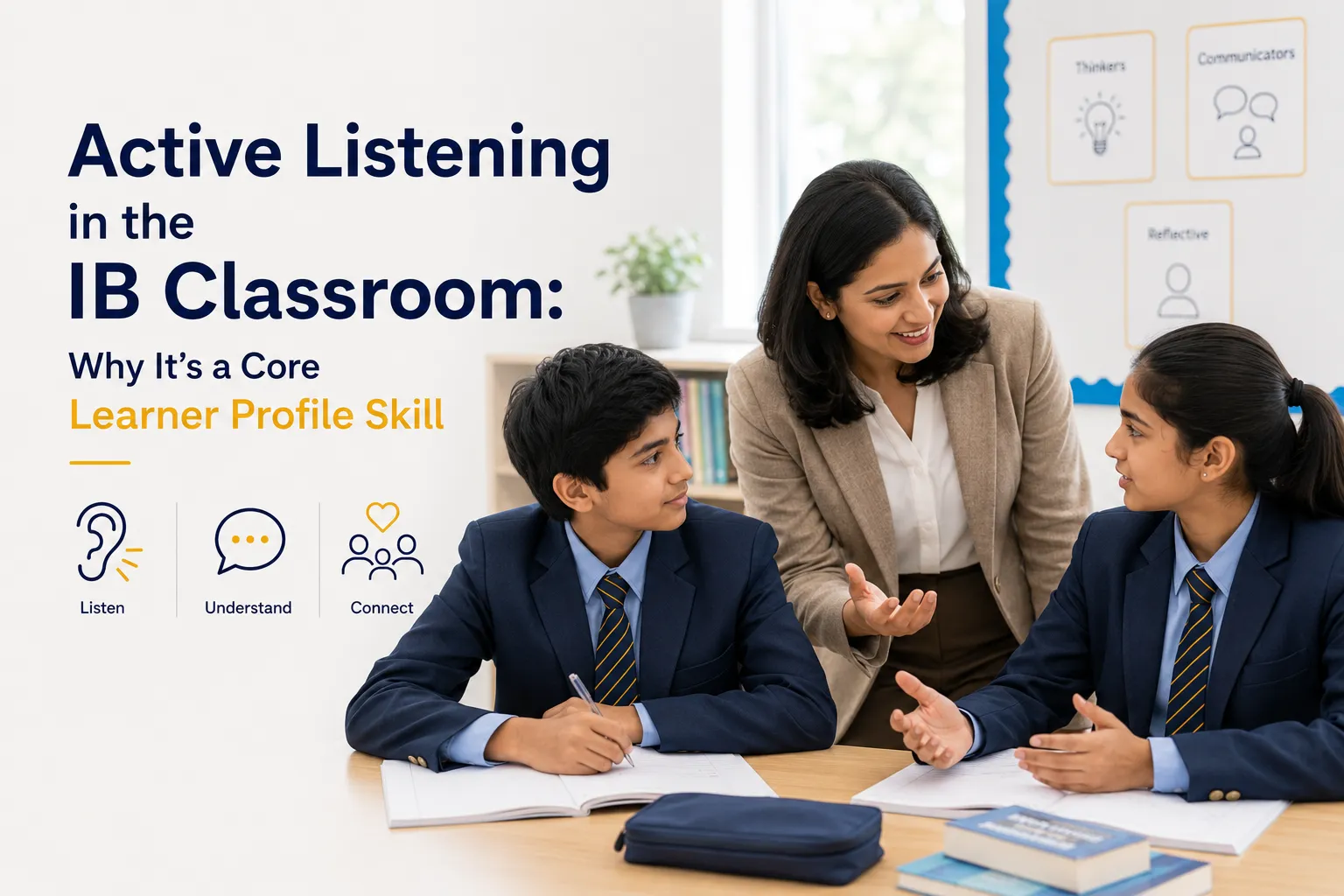
Moments like these demonstrate how active listening naturally leads to inquiry, critical thinking, collaboration and student agency.


This kind of exchange is not accidental. IB teachers design for it explicitly. Circle time, Socratic seminars, think-pair-share activities, collaborative group work, and reflective journaling all build listening muscles systematically. The physical environment matters too: seating arranged for eye contact, a classroom culture where interrupting is gently redirected, and norms like "we respond to the idea, not just the person."


Active Listening Across the IB Continuum

Active listening develops progressively throughout an IB education.


In the Primary Years Programme (PYP), children learn to listen respectfully during circle time, collaborative play and Units of Inquiry.


In the Middle Years Programme (MYP), listening becomes essential for collaborative projects, interdisciplinary learning, discussions and presentations.


In the Diploma Programme (DP), students rely on active listening during seminars, Theory of Knowledge (TOK), group discussions, research collaborations and CAS experiences.


Across every programme, listening supports inquiry, reflection and meaningful communication.


How Parents Can Nurture Active Listening at Home


The work of the IB classroom is significantly amplified when families reinforce the same habits at home. Active listening is not a school skill — it is a life skill, children learn to become better listeners when adults consistently model attentive, respectful communication at home. Children who practise it at the dinner table, during bedtime stories, and in family conversations develop it far more rapidly than those who only encounter it in school.


Five Practices for Families

  • The three-second rule: After your child finishes speaking, pause for three seconds before responding. This models that their words are worth thinking about — not just reacting to.
  • Paraphrase before you reply: Occasionally reflect back what your child said before responding: "So what you're saying is…" This shows listening in action and builds their vocabulary for doing the same.
  • Ask what they heard, not what happened: After a film, a book, or a family conversation, ask "What's something that someone said that stuck with you?" — rather than "What did you do today?"
  • Phone-free mealtimes: Undivided attention is the foundation of active listening. Even one screen-free meal a day creates the conditions for it to grow.
  • Narrate your own listening: When you genuinely hear something that changes your mind, say so aloud: "I hadn't thought about it that way. That actually makes me reconsider." Children learn the behaviour they observe.


The Long-Term Payoff


The case for active listening does not rest only on its role in the IB framework. Research in developmental psychology and educational neuroscience consistently links strong listening skills in childhood to better reading comprehension, stronger social relationships, greater empathy, reduced conflict, and higher academic performance across every subject.


Research also links strong listening skills with improved executive functioning, emotional regulation, collaboration, classroom engagement and leadership development.


More practically: the skills most valued in adult professional life — the ability to lead a meeting, negotiate with a colleague, support a struggling team member, or understand a client's unstated needs — all trace back to the quality of listening developed in childhood. Employers don't say they want people who listened well in school. But they say, repeatedly, that they want people who communicate well, build trust quickly, and understand others. That is active listening by another name.


At Mount Litera School International, we don't treat listening as a background skill. By intentionally developing listening skills from the early years onwards, IB schools prepare students to become reflective communicators, empathetic collaborators and confident lifelong learners that children absorb passively over time. We treat it as a discipline — something taught, practised, reflected upon, and celebrated with the same intentionality we bring to mathematics, language, or science. Because we know that the child who listens well will, in time, think well, write well, lead well, and care well.


And that child will be ready for a world that desperately needs people who are truly paying attention.


Whether participating in a Unit of Inquiry, collaborating on a group project or reflecting on personal growth, students who listen with curiosity and empathy develop the confidence to contribute meaningfully both inside and outside the classroom. Active listening is more than an academic skill—it is one of the foundations of lifelong learning and responsible global citizenship.


References

  1. International Baccalaureate Organisation. IB Learner Profile. ibo.org. Retrieved from ibo.org
  2. Main, P. (2022, August 18). IB Learner Profile. Structural Learning. Retrieved from structural-learning.com
  3. Twinkl. PYP Approaches to Learning. Retrieved from twinkl.com International Baccalaureate. PYP Curriculum Framework. Retrieved from ibo.org
  4. Brightwheel. (2025). Active Listening for Kids: 10 Fun Activities. Retrieved from mybrightwheel.com ScienceDirect. (2024). Listening Challenges in Children: Comprehension and Effort in Noisy and Voice-Degraded Conditions. Retrieved from sciencedirect.com
  5. Hart, B., & Risley, T. R. (1995). Meaningful Differences in the Everyday Experience of Young American Children. Paul H. Brookes. As cited in Tinkercast. (2024). Listen Up! Cultivating Active Listening Skills in the Classroom. Retrieved from tinkercast.com
  6. Hwang, J. Y. et al. (2025). Emotional Intelligence and Conflict Resolution Among Adolescents. World Journal of Advanced Research and Reviews. Retrieved from wjarr.com Research on Preschool and Primary Education. (2025). Active Listening, Students' Well-being, and Educational Environments. Vol. 3, Issue 1. Retrieved from ojs.luminescience.cn
  7. Readability Tutor. (2026). Cultivating Reading Comprehension: Active Reading and Listening Strategies for Children. Retrieved from readabilitytutor.com

FAQs

Active listening is the ability to give full attention to a speaker, understand their message, reflect on what has been said and respond thoughtfully. In IB classrooms, students practise active listening during discussions, collaborative learning, presentations and inquiry-based activities. It supports communication, empathy, critical thinking and respectful dialogue across the Primary Years Programme (PYP), Middle Years Programme (MYP) and Diploma Programme (DP).

Active listening helps children improve communication, concentration, memory, emotional intelligence and problem-solving skills. It also strengthens relationships, builds empathy and encourages children to consider different perspectives. These skills support both academic success and everyday social interactions.

Active listening strengthens several IB Learner Profile attributes, including Communicators, Open-minded, Caring, Principled, Reflective and Inquirers. By listening carefully to different viewpoints, students develop international-mindedness, empathy, collaboration and a deeper understanding of concepts through inquiry.

Approaches to Learning (ATL) are the transferable skills developed throughout an IB education. Active listening enhances Communication Skills, Social Skills, Thinking Skills and Self-Management Skills by helping students collaborate effectively, ask thoughtful questions, reflect on feedback and participate confidently in discussions.

IB educators create opportunities for active listening through circle discussions, think-pair-share activities, Socratic seminars, collaborative inquiry, student presentations, peer feedback, reflective conversations and Units of Inquiry. These experiences encourage students to listen respectfully, ask questions and build on each other's ideas.

Parents can encourage active listening by giving children their full attention during conversations, reading together, asking open-ended questions, modelling respectful communication, limiting distractions during family time and encouraging children to reflect on stories, experiences and different viewpoints. Everyday conversations provide valuable opportunities to strengthen listening habits.

Students who actively listen understand instructions more accurately, participate more confidently in classroom discussions, retain information more effectively and develop stronger critical thinking and problem-solving skills. Active listening also improves reading comprehension, collaboration and inquiry-based learning across all subjects.

Yes. Active listening is one of the most valuable 21st-century skills. It helps students communicate effectively, collaborate with diverse teams, resolve conflicts, think critically and demonstrate empathy—qualities that are highly valued in universities, workplaces and global communities.

Let Your Child's Journey Begin at MLSI

Join one of the top IB schools in Mumbai. Experience world-class education that shapes global citizens.

Contact Us