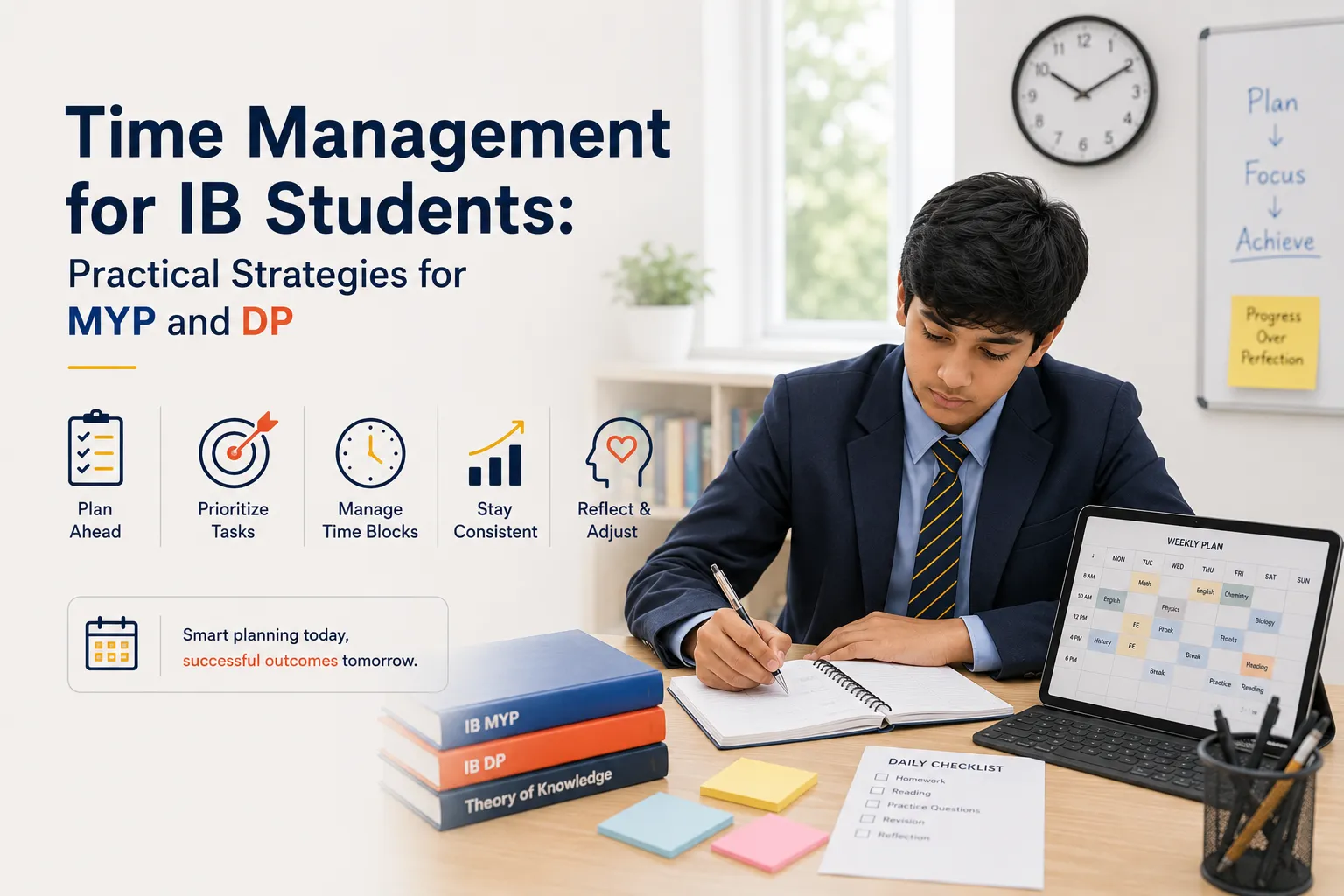
Time management for IB students means planning academic work, assessments, activities and personal time so that students can meet deadlines without relying on last-minute study. Effective IB time management combines prioritisation, backward planning, consistent study routines, reflection and healthy habits such as adequate sleep and regular breaks.
The IB programme is globally recognized for its academic rigor, inquiry-based learning, and holistic approach to education. While the IB journey is rewarding and transformative, students often find themselves balancing multiple responsibilities simultaneously — academics, assessments, CAS, extracurricular activities, leadership roles, projects, deadlines, and personal well-being.
Without proper planning, this balance can quickly become overwhelming. However, effective time management is not about studying all the time; it is about creating healthy routines, prioritizing tasks wisely, and learning how to work consistently and mindfully. With the right strategies, IB students can reduce stress, improve productivity, and create a healthier balance between academics and personal life.
For MYP students, this may mean managing subject assignments, assessments and the Personal Project. For DP students, effective planning becomes particularly important when balancing subject requirements with Internal Assessments (IAs), the Extended Essay (EE), Theory of Knowledge (TOK), CAS and university preparation.
Why Time Management Matters in IB
Multiple Responsibilities
IB students manage several commitments at once:
- Subject assessments and coursework
- Internal Assessments (IAs)
- Extended Essay (EE)
- Theory of Knowledge (TOK)
- CAS experiences
- Personal Project in MYP
- Projects, presentations and extracurricular activities
Unlike traditional systems, IB requires students to consistently work across subjects while maintaining reflection and inquiry.
Long-Term Assignments
The IB framework emphasizes:
- conceptual understanding
- inquiry
- research
- analysis
- reflection
This means assignments are often long-term and require steady planning rather than last-minute memorization.
Balance is Essential
Many students believe productivity means sacrificing sleep or personal time. However:
- sleep improves memory retention
- balanced routines reduce anxiety
- healthy students perform better academically
IB strongly promotes the development of balanced learners.
Time management is important for IB students because the programme involves ongoing learning, assessment, reflection and long-term projects rather than relying only on final examinations. Planning ahead allows students to distribute their workload, meet deadlines, protect time for activities and maintain healthier study habits.
A Life Skill Beyond School
Time management is not only useful during school years. These skills prepare students for:
- university life
- workplace expectations
- independent learning
- leadership responsibilities
- future career planning
Common Time Management Challenges for IB Students
1. Multiple Deadlines Colliding
Students often face situations where:
- summative assessments
- EE deadlines
- CAS submissions
- projects
- presentations
all happen together.
Without planning, students may experience stress, incomplete work, or burnout.
2. Procrastination
Large assignments can feel intimidating, leading students to delay starting tasks. This often results in:
- rushed work
- lower quality submissions
- anxiety before deadlines
- lack of sleep
3. Balancing Academics and Activities
The IB encourages holistic development through:
- sports
- arts
- service
- leadership
- clubs
- competitions
Managing both academics and extracurricular involvement requires discipline and structure.
4. Digital Distractions
Phones, social media, gaming, and notifications silently consume valuable study time every day without students realizing it.
Underestimating How Long Tasks Take
Students sometimes plan according to the time they hope a task will take rather than the time it actually requires. Research, drafting, revision, reflection and unexpected challenges can all take longer than expected. Tracking how long common tasks take can help students create more realistic schedules.
A Simple Time Management System for IB Students
A practical IB study plan does not need to be complicated. Students can use a five-step system to organise their workload:
1. Capture Every Deadline
Record assessments, projects, presentations, meetings, CAS commitments and other important dates in one calendar rather than keeping deadlines across multiple notebooks or apps.
2. Prioritise by Importance and Urgency
Identify which tasks are due soon, which require the most preparation and which can be scheduled for later. This prevents students from spending too much time on low-priority tasks while important deadlines approach.
3. Break Large Assignments Into Milestones
Turn a large task into smaller stages such as research, planning, drafting, feedback, revision and final submission. Smaller milestones make long-term IB assignments easier to manage.
4. Schedule the Work, Not Just the Deadline
Instead of writing only “EE due Friday”, schedule specific work sessions for research, outlining, drafting and editing in the weeks leading up to the deadline.
5. Review the Plan Weekly
At the end of each week, review completed tasks, upcoming deadlines and unexpected changes. Adjust the following week's schedule accordingly. This develops the reflection and self-management habits encouraged by the IB.
Practical Time Management Strategies for MYP Students
Weekly Planner
MYP students should begin using planners to:
- write deadlines
- organize homework
- track assessments
- schedule revision
Helpful Tip:
Use different colors for:
- assessments
- projects
- extracurriculars
- homework
This creates visual organization and reduces confusion.
Break Large Tasks Down
Large projects become manageable when divided into smaller goals.
Example:
Instead of:
“Complete Personal Project”
Break it into:
- Research
- Outline
- Draft
- Reflection
- Editing
Small goals create motivation and consistency.
The 45–10 Rule
Study:
- 45 minutes of focused work
- 10 minutes of short break
There is no single ideal study interval for every student. The 45–10 approach is one practical option; students can adjust the length of focused work and breaks according to their age, concentration, subject and workload.
This helps improve:
- concentration
- retention
- productivity
Prioritize Tasks
Teach yourself to identify:
- urgent tasks
- important tasks
- flexible tasks
Not every assignment requires the same amount of time or energy.
Fixed Study Routines
Consistency is more effective than occasional long study sessions.
Simple routines such as:
- fixed homework timings
- revision schedules
- regular sleep patterns
help students stay organized and mentally balanced.
Practical Time Management Strategies for DP Students
Start IAs and EE Early
DP students can create one master calendar containing IA milestones, EE deadlines, TOK requirements, examinations, university application dates and major school commitments. Seeing these deadlines together makes it easier to identify busy periods before they become overwhelming.
The biggest DP challenge is delaying:
- Internal Assessments
- TOK Essay
- Extended Essay
These tasks require long-term planning and cannot be completed effectively at the last minute.
Best Strategy:
Work in small sections consistently throughout the term.
Backward Planning
Start from the final deadline and work backwards.
Example:
If submission is on 30th August:
- Final Editing → 20th August
- Analysis → 10th August
- Research Completion → 1st August
Backward planning reduces panic and improves organization. Backward planning is particularly effective for IB assignments because it turns one distant deadline into a sequence of manageable milestones. It also creates space for teacher feedback, revisions and unexpected delays.
Avoid Multitasking
Research consistently shows that multitasking lowers productivity and reduces work quality.
Instead:
- focus on one subject at a time
- complete one task fully
- then move to the next task
Build Buffer Time
Unexpected situations always arise:
- illness
- extra homework
- competitions
- school events
Students should leave open spaces in their schedules for flexibility.
Protect Sleep
Sleep is directly connected to:
- concentration
- memory
- emotional regulation
- academic performance
Students who rest properly often perform better than students who continuously sacrifice sleep.
Use a Three-Level Priority System
Students can classify tasks as:
? Priority 1 — Urgent and important: deadlines approaching or work that requires substantial preparation.
? Priority 2 — Important but not urgent: long-term assignments, revision and ongoing projects.
? Priority 3 — Flexible: tasks that can be moved without affecting important deadlines.
This simple system helps students decide what deserves attention first instead of reacting to whichever task feels most stressful at the moment.
The Role of ATL Skills in Time Management
Time management is closely connected to the IB Approaches to Learning (ATL) skills, particularly self-management skills. Students are expected to develop strategies that help them organise their learning, manage time and tasks, set goals, monitor progress and respond constructively to challenges. The IB’s ATL (Approaches to Learning) skills naturally support strong time management habits.
Self-Management Skills
Students learn to:
- organize tasks
- meet deadlines
- manage stress
- reflect on progress
- stay motivated
- set realistic goals
- monitor progress
- adjust plans when circumstances change
Thinking Skills
These skills help students:
- prioritize effectively
- solve problems strategically
- plan long-term tasks
- analyze workload realistically
Communication Skills
Students also learn to:
- ask for help early
- clarify expectations
- collaborate effectively
- communicate progress confidently
MYP vs DP Time Management: What's Different?
Time management looks different as students progress through the IB. MYP students are developing the foundations of organisation, planning and self-management, while DP students typically need to coordinate a larger number of long-term assessment requirements and independent research tasks.
|
MYP Students |
DP Students |
|
Manage subject assignments and assessments |
Manage multiple subject assessment components |
|
Develop planning and organisation habits |
Coordinate IAs, EE, TOK and CAS |
|
Plan for the Personal Project |
Balance coursework with examination preparation |
|
Build self-management skills |
Apply self-management independently |
|
Learn to work towards deadlines |
Manage multiple overlapping deadlines |
|
Develop effective study routines |
Plan sustained revision and independent study |
The goal at both stages is the same: helping students become increasingly independent, reflective and effective managers of their own learning.
Helpful Tools for IB Students
Digital Tools
Useful platforms include:
- Google Calendar
- Notion
- Todoist
- Trello
- Microsoft To Do
These help students organize schedules, reminders, and deadlines efficiently.
Physical Tools
Some students prefer:
- study planners
- sticky notes
- whiteboards
- subject trackers
The best system is always the one students consistently use.
Students do not need to use every productivity app. One reliable calendar combined with a task list and weekly review is often enough. The purpose of a tool is to reduce mental clutter, not create another system to maintain.
Help Students Build Independence
Parents can support time management without managing every task for their child. Instead of repeatedly reminding students about individual deadlines, encourage them to maintain their own calendar, review their workload and decide how they will approach upcoming commitments.
Parents can ask:
“What deadlines are coming up?”
“Which task needs the most time?”
“What is your plan for completing it?”
“Is there anything you need help with?”
This approach provides support while gradually transferring responsibility to the student.
Signs an IB Student May Need to Improve Time Management
Parents and teachers may notice that a student is struggling with time management if they regularly:
? miss or forget deadlines
? leave long-term assignments until the last minute
? frequently work late into the night
? struggle to prioritise competing tasks
? feel overwhelmed by their workload
? sacrifice sleep to complete schoolwork
? avoid starting large or unfamiliar assignments
These signs do not necessarily indicate a lack of motivation. They may mean the student needs help developing planning, prioritisation and self-management strategies.
Tips for Parents Supporting IB Students
Parents play an important role in helping students create healthy routines.
Parents can support by:
- encouraging realistic schedules
- helping students prioritize tasks
- reducing unnecessary pressure
- creating distraction-free study spaces
- focusing on consistency rather than perfection
Most importantly, emotional support matters just as much as academic support during stressful periods.
Time Management is a Life Skill
Success in the IB does not come from studying endlessly. It comes from:
- organization
- reflection
- balance
- discipline
- consistency
Students who learn to manage their time effectively are not only preparing for examinations — they are preparing for life beyond the classroom.
Effective time management is ultimately an exercise in student agency. As MYP and DP students learn to plan, prioritise, reflect and adjust their approach, they become increasingly capable of managing their own learning. These habits extend beyond IB assessments and prepare students for university, professional life and lifelong learning.
The IB journey can be challenging, but with mindful planning, healthy routines, and self-awareness, students can thrive academically while also growing into confident, balanced, and resilient learners.
Key Takeaways
- Effective IB time management is about planning, prioritising and consistency—not studying constantly.
- MYP students benefit from building strong organisation and self-management habits early.
- DP students need to plan carefully around IAs, the Extended Essay, TOK, CAS and examinations.
- Backward planning helps students manage long-term IB assignments.
- Breaking large tasks into smaller milestones makes deadlines more manageable.
- ATL self-management skills are central to effective time management.
- Sleep, wellbeing, physical activity and personal time should remain part of a balanced routine.
- The ultimate goal is to help students become independent, reflective and self-directed learners.
FAQs
IB students can manage their time effectively by recording all deadlines in one calendar, prioritising tasks, breaking large assignments into smaller milestones, scheduling regular study sessions and reviewing their workload each week. MYP students can focus on building organisation and self-management habits, while DP students need to plan carefully around long-term requirements such as IAs, the Extended Essay, TOK and CAS.
Time management is important for IB students because the IB involves continuous assessment, inquiry, reflection, long-term projects and multiple responsibilities. Good planning helps students meet deadlines, reduce last-minute pressure, protect sleep and maintain balance alongside academics and extracurricular activities.
MYP students can manage their workload by using a weekly planner, recording assessment deadlines, breaking projects into smaller tasks and scheduling regular homework and revision time. Learning to prioritise and review their progress also helps MYP students develop the self-management skills they will need for the Diploma Programme.
DP students can manage the IB workload by creating a master assessment calendar, starting long-term tasks early, using backward planning and allocating regular time for IAs, the Extended Essay, TOK, CAS and revision. Building buffer time into the schedule also helps students manage unexpected school commitments or changes.
The best approach is to schedule academics and extracurricular activities together rather than treating them as separate commitments. Students should identify fixed commitments, plan study sessions around them and avoid taking on more activities than they can manage while maintaining adequate sleep and personal time.
IB students can reduce procrastination by breaking large assignments into small, specific actions and setting an early personal deadline before the official submission date. Starting with a manageable task, such as finding three research sources or creating an outline, can make a large assignment feel less overwhelming.
There is no single number of study hours that is appropriate for every IB student. Study needs vary according to age, subjects, assessment periods, learning pace and existing school commitments. Effective time management focuses on the quality and consistency of study rather than maximising hours at a desk. Adequate sleep, breaks, physical activity and personal time should also be protected.
Parents can help by encouraging realistic schedules, providing a quiet study environment and helping students think through priorities without taking over responsibility for their work. Asking questions about upcoming deadlines and plans can help students develop independence and self-management rather than becoming dependent on reminders.
Useful tools include Google Calendar, Notion, Todoist, Trello, Microsoft To Do, physical planners and simple weekly checklists. The best tool is the one a student can use consistently to track deadlines, plan tasks and review progress. Students do not need multiple productivity systems to manage the IB effectively.
Good time management can help reduce avoidable academic stress by giving students a clearer view of their workload and allowing them to start long-term tasks earlier. Planning cannot remove every challenge from the IB, but it can reduce last-minute work and create more predictable routines.