


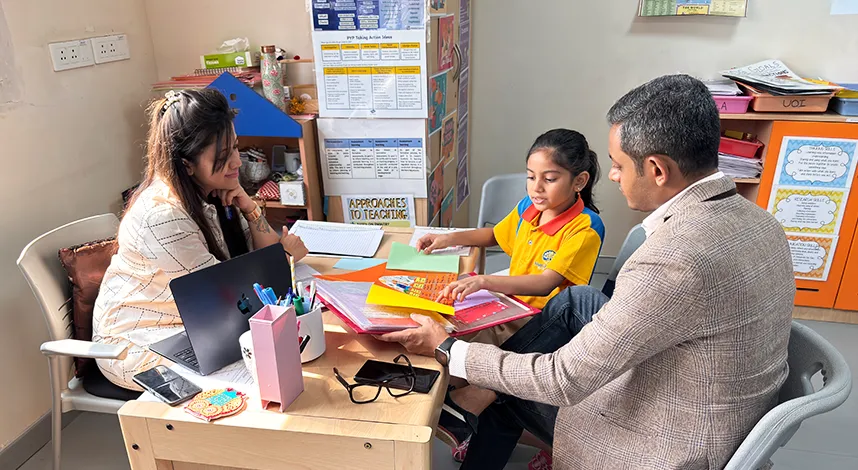
Effective parent-teacher communication is a cornerstone of the International Baccalaureate (IB) education philosophy. Through regular collaboration, student-led conferences, digital portfolios, and ongoing dialogue, IB schools create strong home-school partnerships that support every child's academic, personal, social, and emotional development.
Choosing an International Baccalaureate (IB) education is an exciting milestone for your family. However, parents entering an all-through IB campus often notice that communication looks fundamentally different than in traditional schools. Because the IB focuses on developing independent, self-directed learners from age 3 to 19, the relationship between home and school evolves into a true collaborative partnership.
Parents are recognised as essential partners in the learning journey, working alongside teachers to nurture confident, independent, and internationally minded learners.
In an IB school, communication isn't just about a biannual report card or a quick chat when something goes wrong. It is a continuous, transparent dialogue designed to support your child’s holistic growth across every stage of their schooling.
This collaborative approach ensures that communication focuses not only on academic achievement but also on wellbeing, personal growth, student agency, and lifelong learning skills.
Here is what you can expect from parent-teacher communication in an IB school, and how you can best prepare for it.
How Parent-Teacher Communication Works in IB Schools
IB schools encourage regular, meaningful communication that helps parents understand both what children are learning and how they are developing as learners, communicators, collaborators, and responsible global citizens.
IB schools prioritize active, meaningful touchpoints over passive updates. Here are the primary ways teachers and parents stay connected across all grade levels:
- Student-Led Conferences: In addition to traditional Parent-Teacher Meetings (PTMs), IB schools champion Student-Led Conferences. Instead of the teacher talking about the child while the student sits silently, your child takes the driver's seat. From the primary years to high school, students walk their parents through their portfolios, showcasing achievements, explaining challenges, and sharing personal growth goals.
These conferences encourage student agency by helping learners reflect on their progress, celebrate achievements, identify challenges, and set meaningful goals for continuous improvement.
- A Focus on the Journey, Not Just the Grades: In traditional setups, communication usually centers around raw marks or exam ranks. In an IB school, feedback focuses heavily on Approaches to Learning (ATL) skills and the IB Learner Profile. You will receive updates on how well your child manages their time, how effectively they collaborate in groups, and how they apply critical thinking to real-world problems.
Teachers also provide feedback on communication, collaboration, creativity, resilience, research skills, and self-management, recognising that these transferable skills are essential for success beyond the classroom.
- Continuous Digital Portfolios: Rather than waiting for the end of a term, parents can see ongoing work, teacher feedback, and student reflections in real time through digital learning platforms. This window into the classroom ensures you are always aligned with your child's day-to-day progress.
Digital portfolios encourage ongoing reflection by allowing students, parents, and teachers to celebrate learning milestones while identifying opportunities for future growth.
- Transparent Learning Frameworks: At the start of every academic unit, teachers share curriculum overviews. This keeps you informed about the "Big Ideas" and global contexts your child is exploring, allowing you to extend the classroom learning into your conversations at home.
Understanding the central ideas, lines of inquiry, concepts, and learning objectives allows parents to reinforce classroom learning through meaningful discussions and everyday experiences.
How Parents Can Make the Most of IB Parent-Teacher Meetings
Parents play an active role in the IB learning process by asking thoughtful questions, encouraging reflection, and supporting learning beyond the classroom.
To make the most of this collaborative environment, shifting from a passive listener to an active partner is key. Here are a few ways to prepare for your interactions with IB educators:
- Review the Digital Portfolio First: Before walking into a meeting, check the school’s digital portal. Look at teacher comments on recent assignments so your face-to-face time can be spent discussing long-term developmental milestones rather than catching up on grades.
Looking at student reflections before meetings also provides valuable insights into how children perceive their own learning journey.
- Focus on "How" and "Why" Questions: Instead of asking, "What grade did they get?", try asking questions that align with the IB philosophy:
- How is my child developing their self-management and research skills?
- Which attributes of the Learner Profile are they displaying most naturally in class?
- How can we reinforce the current global themes and inquiry units at home?
- How is my child demonstrating the IB Learner Profile attributes in everyday learning?
- What strengths have you noticed this term?
- Which skills should we continue supporting at home?
- How is my child developing confidence and independence?
- How can we encourage curiosity and inquiry at home?
- Embrace the Concept of Reflection: The IB places immense value on being "Reflective." When discussing an academic or social challenge your child is facing, work with the teacher to help the child identify why the bottleneck happened and how they can pivot.
Encouraging children to reflect regularly helps them become more self-aware, resilient, and responsible for their own learning—key outcomes of an IB education.
Building a Strong Home-School Partnership
The ultimate goal of an IB education is to shape confident, compassionate, and independent global citizens. This transformation happens best when the school and home speak the same language.
Strong partnerships between parents and teachers create consistency between home and school, enabling children to feel secure, supported, and motivated to become lifelong learners.
By actively participating in student-led conferences, focusing on holistic skill development, and engaging with our digital platforms, you help create a seamless support system. Together, as a school community, we can ensure your child feels supported, understood, and empowered to take ownership of their own success from their first day of school to graduation.
When parents, teachers, and students work together with shared goals and open communication, children develop the confidence, resilience, curiosity, and independence needed to thrive in school, university, and life.
FAQs
Parent-teacher communication in IB schools is continuous, collaborative, and focused on the whole child rather than only academic results. Instead of discussing grades alone, teachers and parents regularly communicate about student wellbeing, Approaches to Learning (ATL) skills, the IB Learner Profile, personal development, and progress towards learning goals. Student-led conferences and digital portfolios also encourage children to take ownership of their learning.
Student-led conferences are meetings where students actively share their learning journey with their parents, using portfolios, projects, and reflections to explain their achievements, challenges, and goals. Rather than teachers leading the conversation, students demonstrate their understanding, reflect on their progress, and develop greater confidence, responsibility, and student agency.
Parent involvement is an essential part of the IB philosophy because strong partnerships between home and school help children achieve their full potential. When parents understand classroom learning, reinforce inquiry at home, and maintain open communication with teachers, children benefit from greater consistency, confidence, motivation, and emotional wellbeing.
Approaches to Learning (ATL) skills are a core element of the International Baccalaureate framework. They include communication, research, thinking, self-management, and social skills that help students become independent, reflective, and lifelong learners. Teachers regularly monitor and develop these transferable skills alongside academic knowledge.
Parents can support learning by encouraging curiosity, asking open-ended questions, discussing classroom topics, reading together, promoting reflection, and providing opportunities for children to apply their learning in everyday life. Staying engaged with digital portfolios and maintaining regular communication with teachers also strengthens the home-school partnership.
Most IB schools provide multiple opportunities for communication throughout the academic year, including student-led conferences, parent-teacher meetings, digital portfolios, newsletters, learning management systems, classroom updates, and individual meetings when needed. This ongoing communication helps parents stay informed about both academic progress and personal development.
Strong parent-teacher communication helps students feel supported, understood, and motivated. Research consistently shows that children achieve better academic outcomes, stronger emotional wellbeing, improved confidence, greater independence, and higher levels of engagement when parents and teachers work together as partners in learning.