


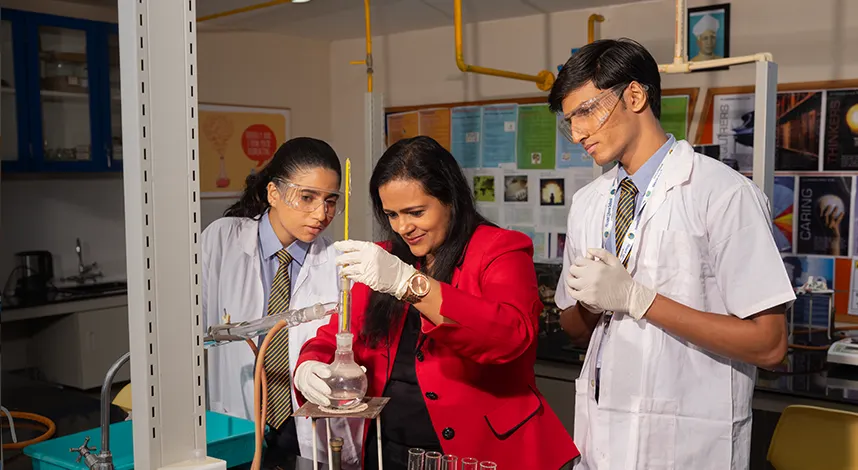
As careers evolve in an AI-driven, globally connected world, education must move beyond memorisation to develop critical thinking, creativity, collaboration, adaptability, and problem-solving. International schools prepare students with these future-ready skills through inquiry-based learning, global perspectives, and internationally recognised curricula that support success in higher education and modern careers.
The world has changed. So should the classroom. Parents today are no longer choosing schools based only on examination results. They are looking for learning environments that prepare children to thrive in an increasingly complex, technology-driven, and interconnected world where adaptability matters as much as academic achievement.
Here's why a global education model isn't a luxury — it's the most practical investment you can make in your child's future.
Imagine spending twelve years memorising answers to questions no employer will ever ask — and graduating unprepared for the ones they will. That is the quiet crisis at the heart of conventional schooling.
India produces over a million graduates every year. Yet study after study reveals the same uncomfortable truth: a significant share of them struggle to demonstrate critical thinking, communicate confidently in global settings, or adapt when faced with problems that don't come with a prescribed answer at the back of the textbook.
The issue isn't intelligence. It's the method. Rote learning — the repetition-and-recall model that still dominates many traditional schools — was designed for an industrial era that needed workers who could follow instructions reliably. The twenty-first century economy needs something entirely different.
The jobs that will matter most over the next decade don't exist yet. Preparing children for those roles means teaching them how to think, not just what to think.
This shift has made international education one of the fastest-growing educational models worldwide, with increasing emphasis on inquiry, innovation, collaboration, digital literacy, and lifelong learning.
Why Rote Learning Alone Is No Longer Enough
Memorisation has a role in education — there is no argument there. Multiplication tables, historical dates, grammatical rules: some things need to be committed to memory before higher-order thinking can begin. The problem arises when memorisation becomes the end goal rather than a foundation.
While memorisation supports foundational knowledge, it is critical thinking, application, analysis, evaluation, and creativity that enable students to solve real-world problems and adapt to changing career landscapes.
When exam success is defined by how accurately a student can reproduce stored information, schools optimise for that output. Teachers teach to tests. Students study to pass. The deeper skills — reasoning, synthesis, persuasion, ethical judgment, resilience under ambiguity — get squeezed to the margins.
In a world where search engines can surface any fact in under a second, the premium on knowing information has dropped sharply. The premium on doing something meaningful with it has never been higher.
Modern employers increasingly value graduates who can communicate effectively, collaborate across cultures, embrace technology, think independently, and continuously learn throughout their careers.
- 85% of the jobs expected in 2030 have not yet been invented. (Dell Technologies & Institute for the Future)
- 90% of employers consider soft skills to be as important as or more important than technical skills. (LinkedIn)
- Students with international exposure and cross-cultural competence are significantly more employable in global workplaces. (NAFSA / QS Employer Research)
Why International Schools Prepare Students for Future Careers
Reason 01
Inquiry-Led Learning Over Passive Instruction
International curricula — whether IB, Cambridge IGCSE, or blended global frameworks — are built around questions, not answers. Students are trained to investigate, hypothesise, debate, and revise their thinking. This produces graduates who are comfortable with ambiguity and energised by problems that don't have a single correct solution.
Inquiry-based learning encourages students to ask meaningful questions, conduct research, evaluate evidence, and develop independent perspectives—skills increasingly valued in universities and modern workplaces.
Reason 02
Global Citizenship as a Core Competency
International schools treat diversity not as a background detail but as curriculum content. Students collaborate with peers from different cultural, linguistic, and socioeconomic contexts, building the cross-cultural empathy and communication fluency that multinationals, NGOs, and startups all say they struggle to find in new hires.
Developing international-mindedness also helps students appreciate diverse perspectives while becoming responsible global citizens capable of working across cultures.
Reason 03
Holistic Assessment That Mirrors Real Work
Rather than reducing achievement to a single end-of-year exam score, international schools evaluate through portfolios, presentations, group projects, and extended essays. This mirrors how performance is actually measured in professional life — and it gives students years of practice in demonstrating capability, not just recall.
Authentic assessment allows students to demonstrate learning through presentations, investigations, collaborative projects, portfolios, and real-world problem solving rather than relying solely on traditional examinations.
Reason 04
Technology as a Tool, Not a Subject
Future careers will be shaped by AI, automation, and data. International schools don't teach technology as an isolated subject — they embed digital fluency across every discipline. Students learn to use technology critically and creatively, which is very different from learning to operate software.
Students also develop digital literacy, media literacy, responsible AI use, computational thinking, and ethical technology practices that prepare them for future careers across industries.
Reason 05
Emotional Intelligence and Leadership Development
International schools invest heavily in social-emotional learning. Conflict resolution, self-regulation, collaborative leadership, and ethical decision-making are woven into daily school life — through advisory programmes, student governance, community service, and structured reflection. These are the qualities that distinguish good professionals from exceptional ones.
Social-emotional learning helps students build resilience, empathy, communication, leadership, collaboration, and self-awareness—qualities recognised as essential 21st-century competencies.
Reason 06
University and Career Pathways Without Borders
An internationally recognised qualification opens doors at top universities across the UK, US, Canada, Australia, Singapore, and Europe — in addition to premier Indian institutions. Students aren't just competing within one system; they're positioned for global opportunity from day one of higher education.
International curricula are recognised by leading universities worldwide, providing students with greater flexibility when pursuing undergraduate education, scholarships, and global career opportunities.
At Mount Litera School International, we have built our pedagogy around a single conviction: children learn best when they are genuinely curious, respected as thinkers, and challenged with real problems. Our curriculum blends the rigour of an internationally benchmarked framework with the cultural depth and values that are distinctly our own.
Students benefit from a balanced education that combines academic excellence, character development, innovation, leadership, creativity, service learning, and global citizenship within a nurturing learning community.
What Makes Mount Litera School International Different?
- A curriculum designed to develop critical thinkers, empathetic communicators, and responsible global citizens — not exam-passing machines.
- Teachers who act as mentors and co-investigators, guiding inquiry rather than delivering monologues. Interdisciplinary projects that connect mathematics, science, humanities, and the arts — reflecting how the real world actually works.
- A vibrant co-curricular ecosystem: debate, robotics, theatre, entrepreneurship labs, and community outreach — because character is built outside the classroom too.
- Robust counselling support to ensure every child's emotional wellbeing keeps pace with their intellectual growth.
- Clear university guidance from Grade 9 onwards, with access to global alumni networks and career mentors across industries.
- Learning experiences that integrate technology, innovation, interdisciplinary thinking, and real-world applications to prepare students for an evolving global economy.
- A strong emphasis on student wellbeing, leadership, service learning, and holistic development that extends beyond academic achievement.
Choosing the Right School for Your Child's Future
Choosing a school is one of the most consequential decisions a family makes. It is also, understandably, one of the most anxiety-inducing. There is pressure — from peers, from relatives, from cultural habits to choose the path that looks proven because it has existed for a long time.
But "proven for what?" is the right question to ask. Proven for producing board exam toppers? Perhaps. Proven for producing professionals who can lead teams through change, found companies, navigate global careers, and contribute meaningfully to a complex world? That is a different standard — and it calls for a different kind of school.
The most valuable education today is one that equips children with the confidence to ask questions, adapt to change, embrace new technologies, collaborate across cultures, and continue learning throughout life.
International education is not anti-academic. It is intensely academic. It simply understands that academic rigour in the twenty-first century looks like depth of thinking, quality of argument, and originality of approach — not the volume of content memorised before a three-hour paper.
The question is not whether your child is smart enough for an international school. The question is whether a traditional model is ambitious enough for your child.
Choosing an international school is ultimately an investment in a child's future—not simply in academic success, but in developing the mindset, skills, and resilience needed to thrive in an uncertain and rapidly changing world.
References
- Dell Technologies & Institute for the Future (IFTF). (2017). Realizing 2030: The Next Era of Human-Machine Partnerships. Retrieved from dell.com
- LinkedIn. (2019). Global Talent Trends 2019. Retrieved from business.linkedin.com LinkedIn. (2024). Most In-Demand Skills 2024. Retrieved from linkedin.com
- NAFSA. (2021). How College Contributes to Workforce Success. Retrieved from nafsa.org QS. (2020). Global Employer Survey. As cited in IIE's Why Study Abroad. Retrieved from iie.org
FAQs
International schools focus on developing critical thinking, creativity, collaboration, communication, and problem-solving alongside strong academic knowledge. Unlike traditional rote-learning models, international curricula encourage inquiry-based learning, real-world application, and independent thinking, helping students become confident, adaptable learners who are better prepared for higher education and future careers.
International schools provide globally recognised curricula, personalised learning, holistic development, international-mindedness, and opportunities to build leadership, communication, and intercultural skills. Students benefit from inquiry-based classrooms, project-based learning, authentic assessments, and greater exposure to technology, innovation, and global perspectives that prepare them for university and careers worldwide.
International schools prepare students for future careers by developing transferable skills such as critical thinking, creativity, collaboration, communication, digital literacy, leadership, adaptability, and ethical decision-making. These competencies are increasingly valued by universities and employers in an AI-driven, technology-enabled global economy where continuous learning is essential.
Yes. International curricula such as the International Baccalaureate (IB) Diploma Programme and Cambridge International qualifications are widely recognised by leading universities across the UK, USA, Canada, Australia, Europe, Singapore, and many other countries. Their emphasis on research, analytical thinking, independent learning, and academic rigour helps students transition successfully into higher education.
Inquiry-based learning is a teaching approach that encourages students to ask questions, investigate ideas, analyse information, and develop their own understanding rather than simply memorising facts. By actively exploring real-world problems, students build critical thinking, curiosity, research skills, and confidence while becoming more engaged and independent learners.
Critical thinking enables students to analyse information, evaluate different viewpoints, solve unfamiliar problems, and make informed decisions. In a rapidly changing world where information is readily available, the ability to think independently and apply knowledge creatively is more valuable than simply memorising facts. Critical thinking is recognised as one of the most important skills for academic success and future employability.
Modern employers increasingly seek graduates who demonstrate communication, collaboration, creativity, adaptability, digital literacy, leadership, emotional intelligence, cultural awareness, and problem-solving abilities alongside technical expertise. International schools intentionally develop these future-ready competencies through interdisciplinary learning, teamwork, presentations, research projects, and real-world experiences.
Mount Litera School International combines internationally benchmarked academic standards with inquiry-based learning, interdisciplinary experiences, leadership development, technology integration, and holistic education. Students develop intellectual curiosity, global perspectives, strong values, and lifelong learning habits while preparing for leading universities and careers in an increasingly interconnected world.